Marketplace Guides
1688 API: Integrating the Chinese Marketplace with Online Stores and E-commerce Projects
Integrate 1688 with your online store using API. Access product data, prices, images, variants, suppliers and search features for e-commerce projects.
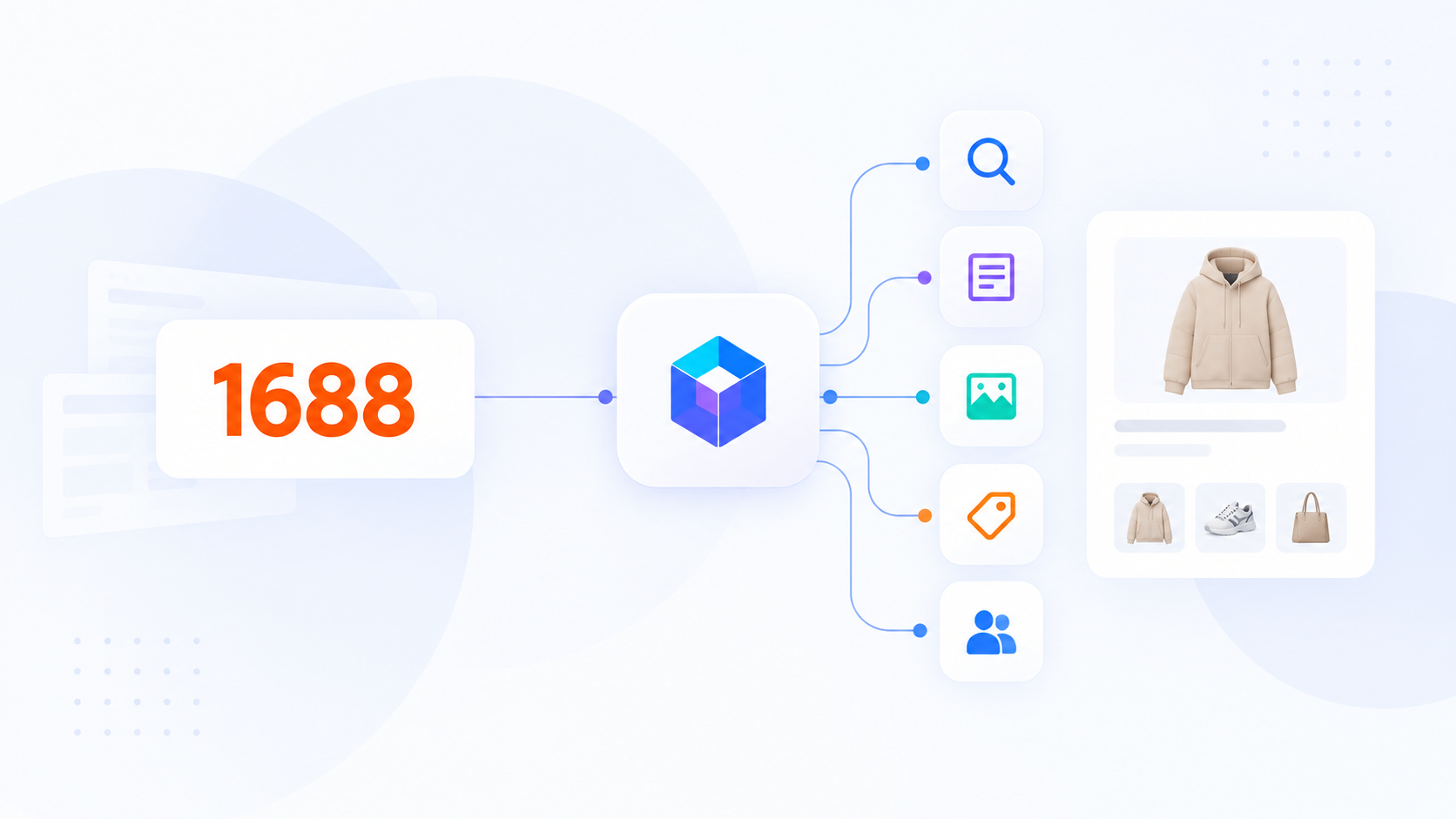
1688.com is one of China’s largest B2B marketplaces for finding manufacturers, suppliers, and products for wholesale purchasing. The marketplace is part of Alibaba Group and is primarily focused on the domestic Chinese market.
For e-commerce projects, 1688 is particularly attractive because of its extensive product range, the ability to work directly with Chinese suppliers, and pricing designed for wholesale purchases. However, working manually with such a large catalog can be inefficient, especially when product information, prices, specifications, and supplier data need to be retrieved and updated regularly.
The 1688 API makes it possible to automate these processes and use marketplace data in online stores, applications, product management systems, and other e-commerce solutions.
What Is the 1688 API?
The 1688 API is a programming interface that allows applications to automatically retrieve and process information from 1688.com.
Instead of manually searching for products and transferring information into your own system, requests can be performed programmatically. The retrieved data can be used to build product catalogs, implement product search, synchronize information, and provide other online store functionality.
For example, a customer searches for a product in your online store. The system sends a request to the API, retrieves relevant products from 1688, and displays the results directly within your website interface.
The API can also retrieve detailed information about a selected product and use it to create a product page in your own store.
What Data Can You Retrieve Through the 1688 API?
The functionality depends on the specific API method and integration. The API can provide access to key 1688 catalog data, including:
product titles and IDs;
prices and wholesale price ranges;
product images;
descriptions;
specifications and attributes;
product variants and configurations;
categories;
seller or supplier information;
available shipping information;
search results;
additional information available on product pages.
Structured data makes it possible to automatically transform marketplace information into the format required by your online store or application.
Searching for Products on 1688 via API
One of the main integration capabilities is the 1688 Product Search API.
It allows you to implement 1688 product search directly within your own website or application. Users do not need to visit 1688: the search request is sent through the API, and the results are displayed in your own interface.
Depending on the API method, additional parameters and filters can be used to refine search results.
Another useful feature is image search (1688 Image Search API). A user uploads a product image, and the system searches 1688 for similar products and offers.
This functionality is particularly useful for supplier sourcing services and projects where the starting point for finding a product is an image rather than a product name or SKU.
Retrieving Full Product Information
After finding a product, the next step is usually to retrieve its complete information.
The 1688 Item API can be used to retrieve the data required to create a product page, including the title, images, price, specifications, variants, description, and other available information.
This makes it possible to automatically build your own product catalog using supplier products.
For example, a typical workflow may look like this:
Search → Select product → Retrieve full product information → Process data → Add to online store catalog
Before publishing the product, the retrieved information can be processed according to your business requirements: titles and descriptions can be translated, category structures can be modified, prices can be recalculated, and custom markup rules can be applied.
Working with Product Variants
Correct handling of product variants is particularly important when working with 1688.
A single product may have many different configurations, such as:
colors × sizes × configurations
Each combination may have its own price, identifier, and other parameters.
The API makes it possible to transfer this structure to an online store’s information system, where it can be converted into standard product variants.
This is significantly more convenient than manually creating dozens or even hundreds of combinations for each product.
Supplier Information
1688 is primarily a B2B marketplace, so supplier information can be just as important as product information.
Relevant API methods can provide available supplier data that can then be used in your own business processes.
For example, a product sourcing service can maintain the following relationship:
Product → Offer → Supplier
This makes it possible to build more advanced procurement and catalog management systems.
Integrating the 1688 API with an Online Store
The API can be integrated with virtually any platform that supports server-side integrations.
A typical architecture may look like this:
1688 → API → Online store backend → Your database → Storefront
The backend sends requests to the API and receives structured data. The application can then store the required information in its own database and display it to customers.
This approach prevents the internal structure of the online store from being directly dependent on the structure of 1688.
The integration can be used with Shopify, WooCommerce, OpenCart, Magento, Laravel, custom e-commerce platforms, and other systems.
1688 API vs. Scraper: What Is the Difference?
When looking for integration solutions, you may also encounter terms such as 1688 scraper, 1688 scraping API, or 1688 data scraper.
A scraper typically retrieves information directly from website pages and converts it into a structured format. An API provides an application with a predefined interface for sending requests and receiving responses.
From a developer’s perspective, the final workflow may look similar:
Request
↓
1688 API
↓
Structured JSON
↓
Application
When choosing a solution, it is important to consider not only how the data is obtained, but also API stability, response speed, request limits, and the provider’s ability to adapt to changes in the underlying data source.
Why Use a Ready-Made 1688 API?
Developing an integration from scratch requires building and continuously maintaining your own data retrieval infrastructure.
Marketplaces regularly change their pages, internal interfaces, and data structures. As a result, an integration that works today may require modifications in the future.
Using a ready-made API allows you to focus on your own product.
For developers, the process is straightforward:
Send a request → Receive data → Use it in your application
The API provider handles the infrastructure required to retrieve and normalize the data.
1688 API by Setalabs
Setalabs provides API infrastructure for working with data from 1688 and other popular marketplaces.
With a unified integration approach, developers can access the data required for online stores, product sourcing services, catalog management systems, and other e-commerce projects.
Using Setalabs helps reduce the amount of infrastructure required to integrate a marketplace, allowing development teams to focus on building their own products.
If you would like to test the 1688 API, explore the available methods, or discuss an integration for your project, contact the Setalabs team to request test access.